
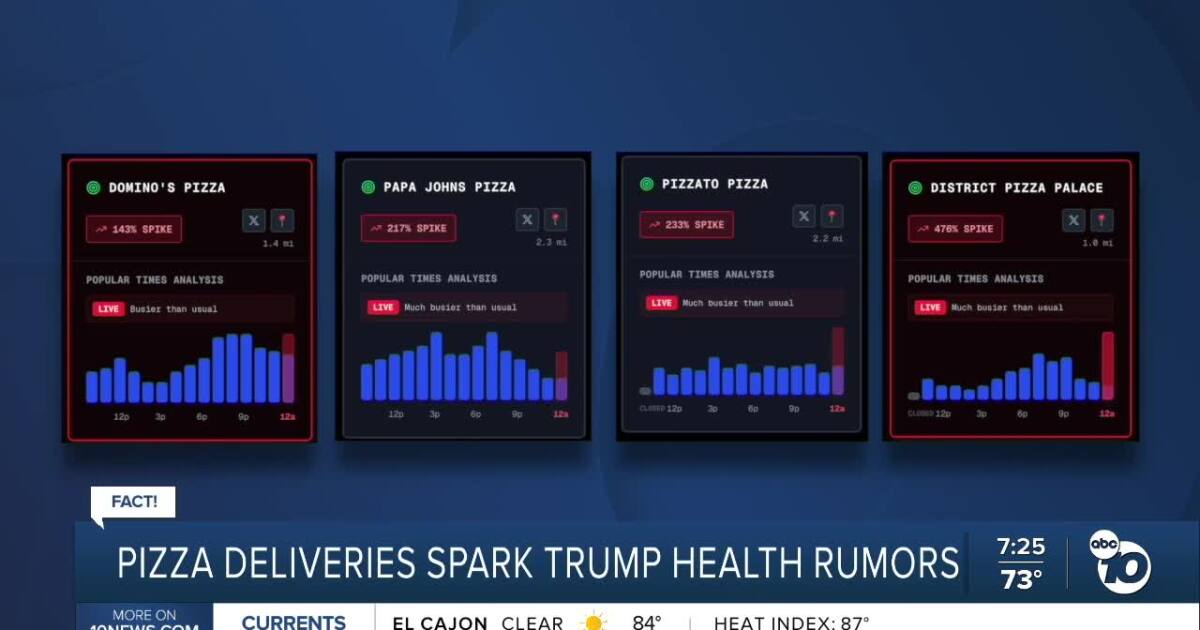
In recent days, rumors surrounding former President Donald Trump’s health have gained traction, particularly fueled by an unusual spike in pizza deliveries to the Pentagon. This odd connection has sparked conversations across social media and news platforms, examining the implications of this culinary curiosity on the political landscape.
Over the weekend, a notable increase in pizza orders near the Pentagon raised eyebrows and conspiracy theories. The Pentagon Pizza Report, a somewhat informal metric, indicated that a high volume of pizza deliveries typically signifies heightened activity among military and government personnel. This correlation has a historical backdrop; significant military events such as the U.S. invasion of Panama in 1989, Operation Desert Storm in 1991, and recent events concerning Israel and Iran were preceded by similar spikes in pizza deliveries. Supporters of this theory speculated that the recent surge could indicate something serious regarding Trump’s health, especially since he had not been publicly seen for several days.
While these theories have circulated rapidly, it’s crucial to emphasize the lack of credible evidence suggesting that Trump is facing any serious health issues. Speculation can catalyze fear and confusion but is often rooted in misinformation or circumstantial observations. Many critics argue that connecting pizza deliveries to presidential health incidents is an oversimplification and not a substantial basis for legitimate concern.
This situation raises important questions about how information spreads in the digital age, especially concerning public figures like Trump. Given his polarizing nature, any absence from the public eye tends to ignite speculation, regardless of the underlying reasons. Indeed, Trump’s health, both physical and mental, has long been a topic of scrutiny, often amplified by his opponents. Issues such as his age, weight, and previous health incidents naturally fuel ongoing anxiety among his supporters and adversaries alike.
The phenomenon of “food-as-indicator” extends beyond just pizza; it can encompass various consumption patterns that signal ordinary activities versus extraordinary circumstances. In this case, if the Pentagon staff are indulging in late-night pizza, the assumption is that they are involved in gathering information or strategizing about national security matters. Yet, such conjectures hinge on anecdotal evidence rather than rigorous investigative reporting.
As the public digests these rumors, it’s essential to maintain a balanced perspective, grounded in factual reporting and critical thinking. Reports should emphasize that while monitoring pizza orders may make for entertaining conjecture, they are hardly reliable indicators of real-world events, especially concerning a public figure’s health. This is why responsible journalism is crucial; not every story needs a sensational angle, especially when the truth may be far less dramatic or interesting, simply suggesting that the former President is taking time away from public engagements for personal reasons.
Moreover, the impacts of this kind of speculation can extend beyond mere political gossip. The conjecture surrounding Trump’s health can contribute to societal divisions, reinforcing existing biases among voters and detractors. Political discourse, particularly concerning health, is often wrapped in emotional narratives, complicating straightforward discussions about wellbeing, leadership, and national security.
The recent pizza rumors serve as a warning about the susceptibility of the public to sensational stories. More so, misinformation can lead to heightened anxiety and distrust in institutions, making it a double-edged sword. Just as a report like the Pentagon Pizza Report can entertain and amuse, it can also generate consequential misunderstandings that ripple through the political landscape.
In conclusion, following every twist and turn in political narratives, particularly regarding health, requires scrutiny and a discerning mindset. While the pizza surge near the Pentagon might spark lively debates and theories, one must remain grounded in factuality and pragmatism. The truth, often mundane and less exciting than speculation, is paramount. Rather than letting pizza deliveries dictate the narrative of a former President’s health, it would be prudent to navigate such topics with a clearer head and unwavering reliance on credible information. The art of discerning fact from fiction calls for both diligence and patience, especially in an era where information travels faster than verification.
Source link


